Quality Management: The heart of the Quality Assurance/Quality Control process

Oscar Dominguez1

1 Global Principal Geoscientist QAQC, Technical Centre of Excellence, BHP, Perth, Australia. oscar.r.dominguez@bhpbilliton.com

Business decisions in society and across a wide swath of industry sectors are often data-driven, making sampling reliability and analytical data quality of paramount importance. Quality Management (QM) plays a vital role in the Quality Assurance/ Quality Control process. Oscar Dominquez here presents the critical role of QM in the mining sector, where everything is BIG: tonnages, challenges, environmental impact, profits, risks—illustrating how proper sampling is a major critical success factor also here. But the mining sector view is not unique; the QM prerogatives can be carried over to very many other sectors as well.

Mining: where everything is BIG

In the mining sector, decisions and investments in exploration, infrastructure construction, mining operations, ore processing and transportation require multi-million dollar capital and operating budgets, but critical decisions can be based only on very small samples (of the order of a few grams) that are supposed to represent thousands of tons. It is clear that the compound, complex lot-to-analysis pathway must be representative in all stages, Figure 1. The Theory of Sampling (TOS) is a self-evident element in the full Quality Management (QM) scope.

This was one of the most influential observations that led Pierre Gy to develop the TOS and later led researchers such s Dominique Francois-Bongarcon and Francis Pitard, among others, to promote, convince, quantify and demonstrate to executives and mining professionals the severe risks to which businesses expose themselves should they compromise sample quality in a misguided attempt to reduce costs. Over many decades, examples of this practice have been accumulating, but not many have been published (for obvious reasons). It will suffice to refer to two major communications from the sampling world. 1,2

In this context, supervisory programmes have been developed to establish Quality Assurance/Quality Control (QA/QC) parameters that monitor correct execution of sampling protocols and control each stage of the “sampling cycle” [sample collection, preparation and analysis (method)] to preserve, quantify and ensure sample representativity, Figure 2.

QA/QC reports commonly include statistical–numerical results that quantify performance of QA/QC controls (field duplicates, preparation duplicates, blanks, standards etc.). Graphics such as scatter plots, QQ plots, histograms and cumulative frequencies are used to represent the results graphically. Statistical values normally include, for example, relative differences, absolute differences, relative variance, averages, T-test and Z-scores, which are used to quantitatively express the relationship between duplicate pairs… However, is an effective quality programme simply just a statistical exercise? And will pairwise comparisons be able to detect all possible wrongdoings (especially be able to detect a sampling bias)?

The following discussion considers these questions in the context of a quality programme standard as outlined by the JORC code (http://jorc.org), that is intended to highlight and emphasise a call to return to basics during this era of new technological applications and advanced statistical analysis.

The case for proactivity

This paper aims to highlight the concept of “QM” as the precursor for appropriate corrective actions to close gaps determined by the execution of a quality programme, specifically trend analysis (by ranges time and/or grades), with the aim of proactively determining control performance deviation and thus proactively rectify the source of deviation.

Figure 1. The mining value chain. Rectangles indicates where samples (and their analytical results) are used to support critical business decisions.

Sometimes, there is confusion among those accountable for QA, and even among auditors, that if individual data points fall within predetermined acceptance limits, they are then necessarily acceptable and, therefore, suitable as a basis for operational and investment decisions. A similar situation is that tabular statistical summaries are enough to demonstrate acceptability of QC outcomes. However, what is stated with respect to QM is that sometimes results found within the acceptance limits can be de facto internally biased, or show material deviations over a period of time, thereby still impacting operational performance. An unstable process which happens to plot within acceptance limits for some restricted time interval is nevertheless an unstable process at large. Thus, true process control requires something more.

QM refers to reliable proactive detection of such “anomalous tendencies”; that is, the trend over time/grade of a given statistic. QM specifically also includes the process by which these trends are understood, communicated and rectified. Some businesses refer to this process as “continuous improvement” or as the “Plan–Do–Check–Act” cycle. In the mining industry, this proactive approach can have significant impact on financial outcomes through sequence optimisation, contract negotiation, and management of plant and processing infrastructure.
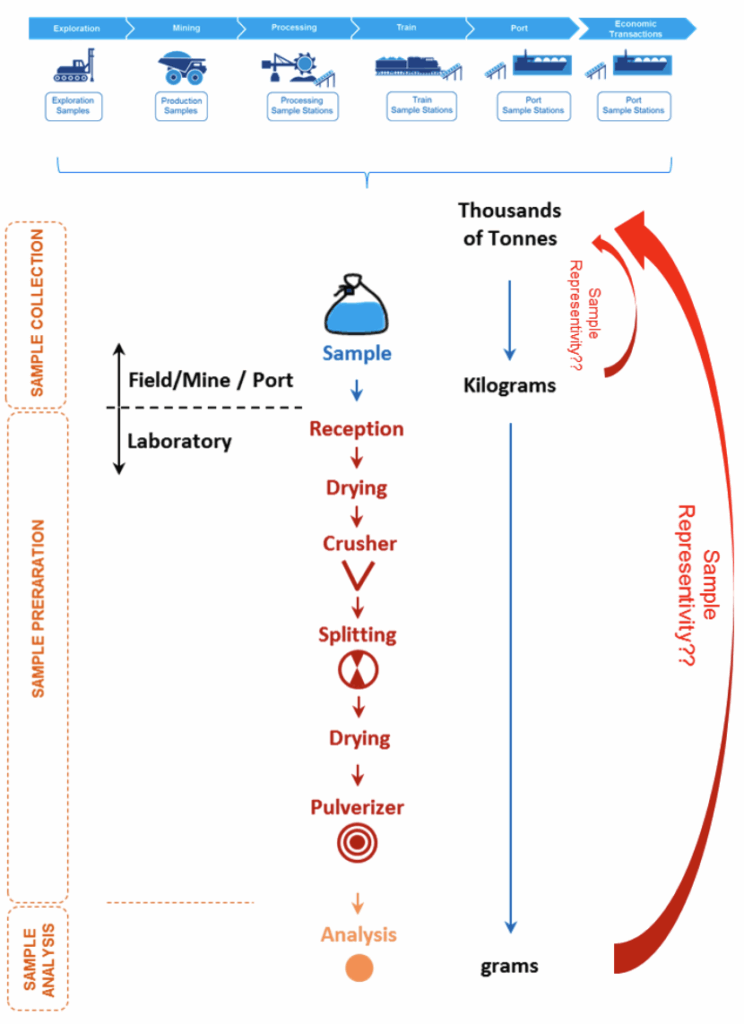
Figure 2. Schematic diagram showing a generalised process and appropriate quality requirements for samples collected across the full mining value chain. The main goal of a quality programme is highlighted: to preserve, quantify and ensure sample representativity.

Examples of QM in the mining value chain

Below are presented examples of how QM can be implemented throughout the mining value chain, using a proactive approach as guided by JORC Table 1 (http://jorc.org/docs/JORC_code_2012.pdf#page=26) and how results are typically presented in QA/QC reports or audits.

Sampling (“sample collection”)

JORC Table 1 provides guidance that drilling campaigns shall deploy measures to maximise sample recovery and representativity. A typical example for a reverse circulation (RC) drilling campaign would be to compare actual sample weights to a theoretical “ideal” drilling recovery, as a function of material density, rod length and diameter, and aperture size of the sample shoot (Figure 3).
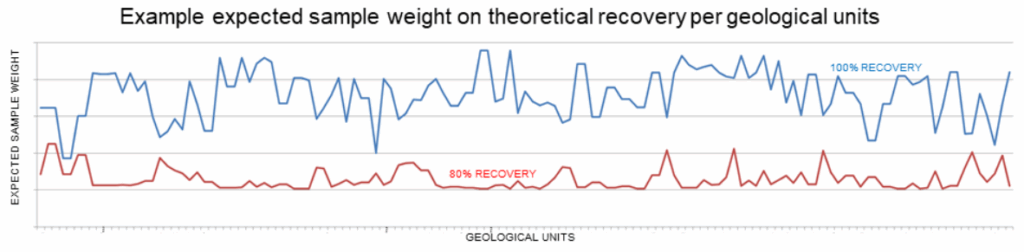
Figure 3. Comparing actual sample weights to a theoretical “ideal” drilling recovery.

Where duplicate samples are collected, it is expected that they will have similar, if not identical, sample weights. This is considered a satisfactory indication that the rig set-up, sampling devices and drilling/sample collection process are operating according to design, Figure 4.
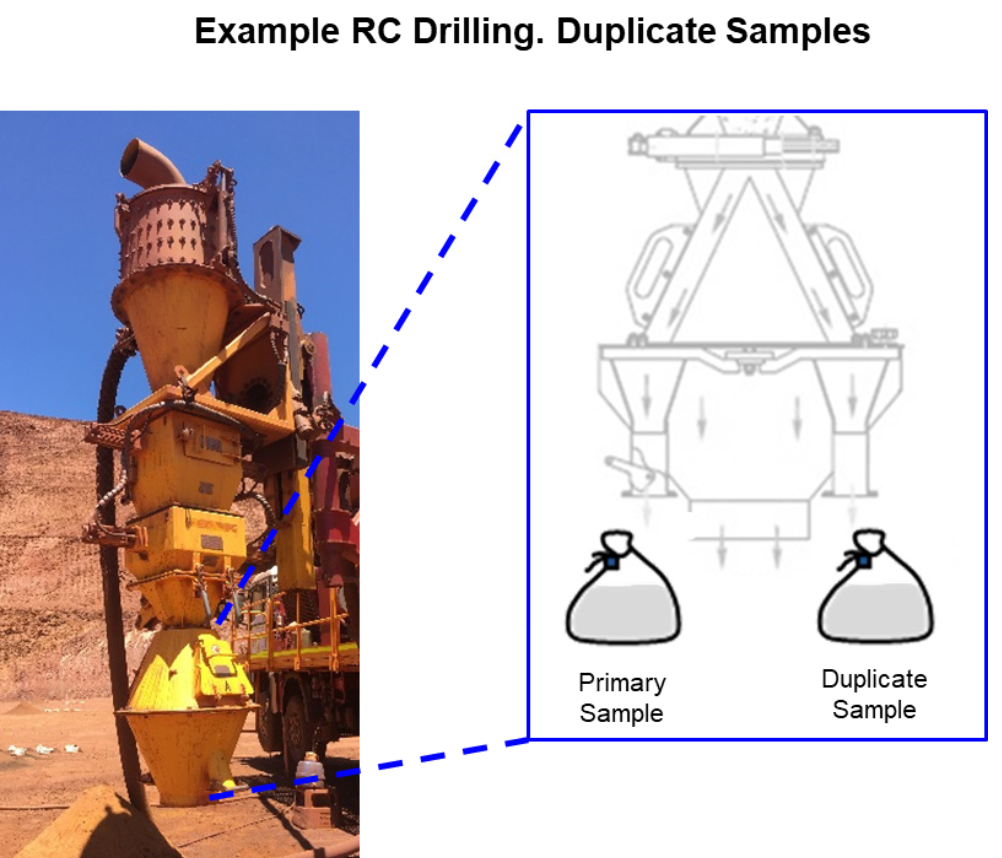
Figure 4. Duplicate field sample production directly at RC drilling site is considered a satisfactory sampling quality assurance if weight are closely similar.

Results are commonly presented as in Figure 5, in which a scatter plot shows the distribution of the results between duplicates. In this example, the scatter plot shows differences in weight outside expected thresholds, between 10 kg and 30 kg; and potentially a small bias towards to sample A being heavier than sample B.

However, there are several questions this graph fails to answer: why are A samples systematically larger than B samples? Is this the consequence of a particular drill rig? Or of a particular sampling device? When was the bias first introduced? Is this bias random, or sustained for a period of time? What was done to fix it?
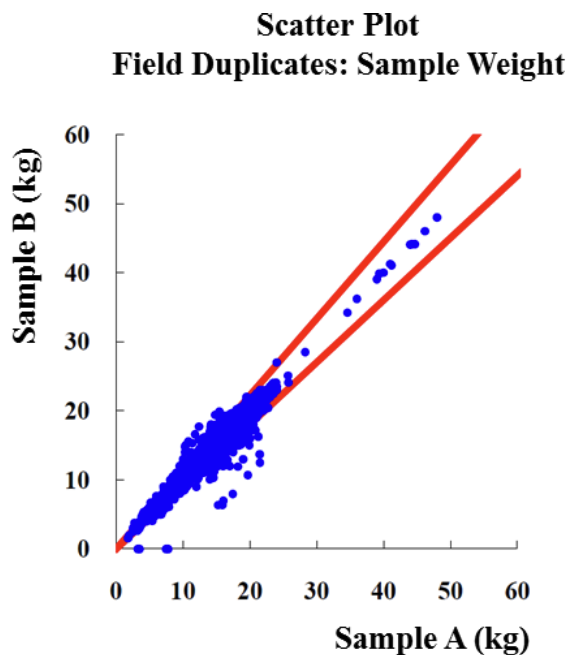
Figure 5. RC field duplicates performance: scatter plot comparison of duplicate sample
weight. 

Figure 6 presents an example of how QM practices can proactively improve sample collection by monitoring rig performance in a different way, while still comparing the weight of duplicate samples.

Figure 6 can be interpreted as follows: during the first two weeks of drilling in February, weight differences in rig were not performing within accepted thresholds (Relative Difference ± 20 %). A conversation with the drill crew and drilling company supervisor is conducted in the field to explain to the driller the importance of drilling on geological models, to understand the sources of this poor performance, develop an action plan to improve the sampling practice and obtain a commitment to increase sample quality.
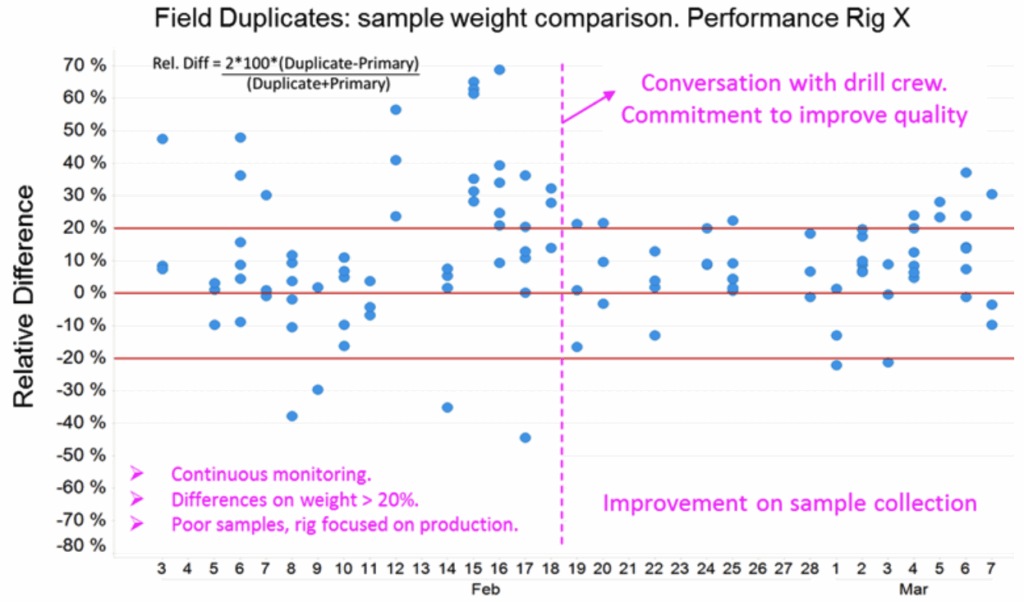
Figure 6. Example of monitoring sample weight on duplicate samples. Quality Assurance (QA): collect sample weight on duplicate samples. Quality Control (QC): sample weight within ± 20 % relative difference. Quality Management (QM): continuous monitoring of the information and actions were results are outside expected thresholds.

Through QM, corrective actions are taken by continuously monitoring results over time. This proactive approach can save thousands of dollars by “doing things right the first time” rather than reviewing QA/QC performance en masse once the drilling campaign is already finished, by which time it is too late, by far!

Sample preparation

Following the same criteria as for Sampling above, the JORC Table 1 benchmark requires evidence that “quality control procedures [are] adopted for all sub-sampling stages to maximize representivity of samples”.

Usually, blanks, duplicate samples and sizing tests are used as a QA tool to monitor the performance of crushers and mills. Later, results are included on QA/QC reports where the performance of crushers and mills are summarised, for example as shown in Figure 7.

While these graphs and summary tables are typical in a great many mining practices today, this information does not allow the application of QM to monitor the information in real time and proactively improve the results. How can an improved practice be designed and implemented? Again, time/grade-related trends are key!

Figure 8 shows an example where a trend analysis is performed both on a time (date) and on a grade basis: A) The Absolute Difference of Duplicate samples is plotted against the date the laboratory has reported the results. The graph does not show major issues over a specific period of time, but if the data is assessed on a grade basis as shown in B), a trend can be in fact be observed and interpreted as the grade of the primary sample being greater than the uplicate sample. The action here will be to talk to the drilling company (if these are field duplicates); or with the team performing the core cutting, or with the laboratory if the data are crusher or pulp duplicates—in order to find the source of this bias, and develop an action plan to fix and close the gap. This real-time assessment and management is the basis for the desired proactive approach. It needs to be highlighted, supplementing reactive activities such as reconciliation results or monthly/quarterly QA/QC reports (if done), where the opportunity for fixing issues in near-real time is lost.
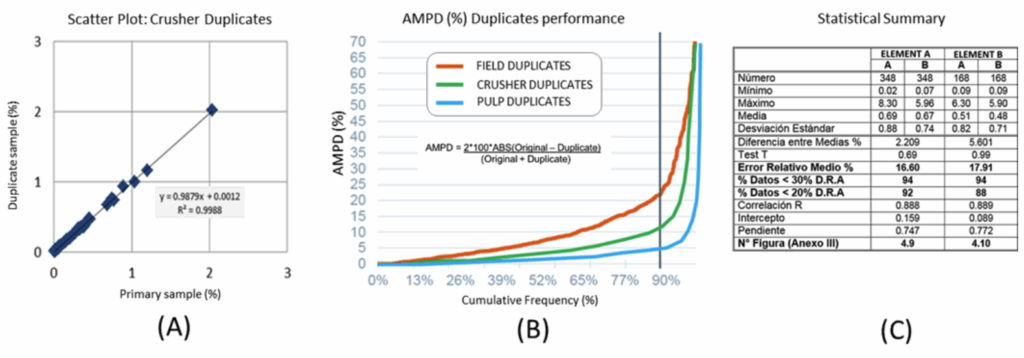
Figure 7. Examples of how duplicate samples performance are presented in QA/QC reports. (A) and (B) show different type of graphs to visualise and determine the correlation of the samples (A) and the % of data (B) on a certain % of difference, expressed as AMPD.

Chemical determination

Certified Reference Materials (CRMs) are extensively used to monitor laboratory performance, and mining companies are obliged to arrange preparation of their own internal Working Reference Materials to perform QM. It is not recommended to rely on internal laboratory QA/QC processes only. Changes in the lab results or consistent biases across time are best detected by an external team accountable for QM, in order to highlight issues within the laboratory, to identify sources of deviations and their production consequences, and to generate an action plan and apply lessons learned to avoid repetitive issues.

Often statistical analyses consider “average values”, which sometimes lead to inaccurate conclusions that assume a process is well controlled “on average”, or “fit for purpose”. QM applies a different approach, assessing data in real time, thereby escaping the use of time-averages, and keeping an appropriate business focus with the aim to ensure consistent and defensible results, supporting sustainable business decisions.
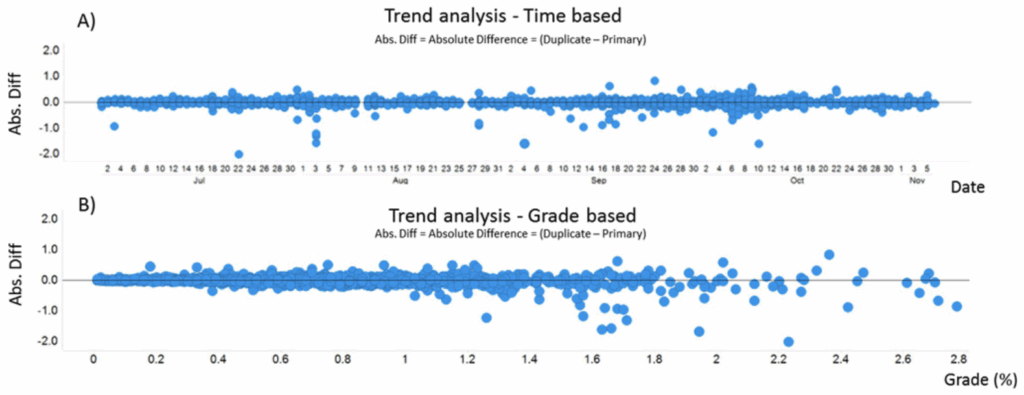
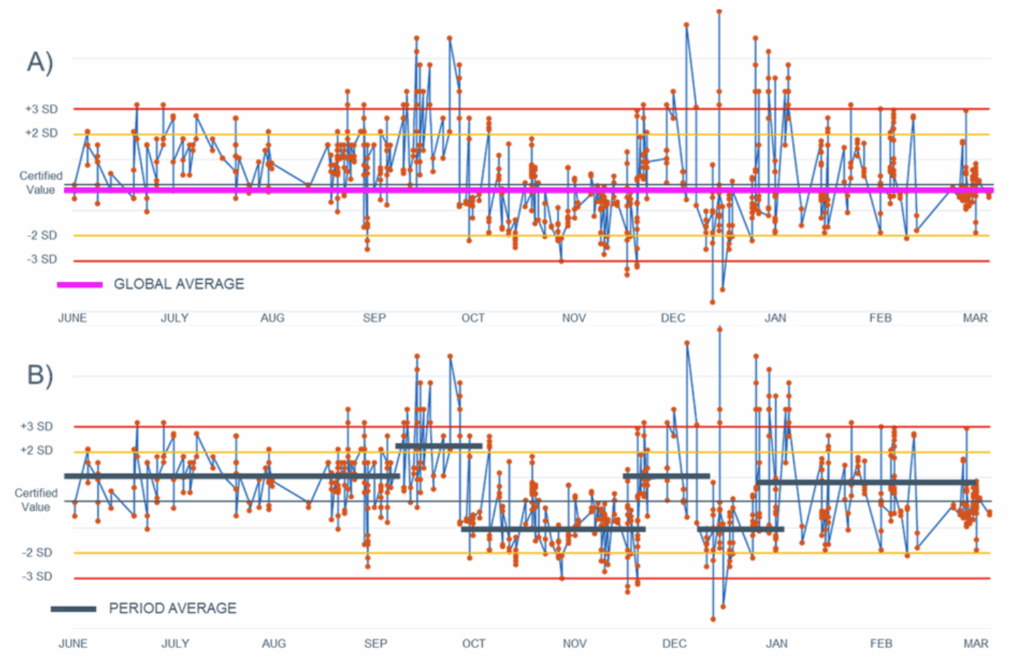
Figure 8. Examples of trend analysis performed on a time and grade basis for duplicate samples (applicable for field, crusher and pulp duplicates). These graphs highlight the value of performing QM both on a date and grade basis: the analysis by time (date) does not reveal any major issue in terms of bias and the results look consistent. However, trend analysis performed on a grade basis highlights a bias at high grades that needs to be reviewed, understood and fixed.
Figure 7. CRM performance showing results performing mostly within three expected standard deviations. A) Global average is very close to the certified value, which can be interpreted as the results are considered valid. B) Period average has been included, showing the significant time-variability of the laboratory performance during individual months.

Figure 9 demonstrates the differences between an approach reliant on averages vs QM applied to CRM results (QA = CRMs, QC = ± 3 SD and QM = trend analysis). Figure 9A shows 10-months’ performance of a CRM. Because results have been performing mostly within three standard deviations, the business might infer the process is well controlled and would feel confident, given the global average is close to the certified value.

However, Figure 9B shows the internal variability which the laboratory (period average) is observing over time. This lack of consistency gives rise to operational instability, exposing the business to risks of under- or over-performing at production, processing and compliance to plan results, or leads to variable products.

These are examples of cases where QM becomes important by monitoring information in real time and detecting changes in the performance of the laboratory proactively, thereby ensuring consistency and sustainability of business results.

Conclusions

This column highlighted that a quality programme is not just a statistical exercise, where global averages or standard deviations assure sustainable and consistent QA/QC results. The examples provided demonstrate the value of QM to complement routine QA/QC processes and statistical analysis, enabling a QM proactive approach in which data monitoring will ensure consistent results across time or, over a range of grades, will reduce resource and operational risks, and allow business decisions based on representative and quantified-quality information across the entire value chain. Indirectly this paper also highlights the value and necessity of having a central (external) QM team which is accountable for governance and for performing appropriate quality-related activities (QA/QC and QM) across both exploration and production.

Finally, QM is currently in vogue and companies have been pushing to be part of “a new era” of new technological applications (sensors) and data analysis (machine learning, conditional simulations etc.), which is trying to provide businesses with real-time data to be used for business decisions in real time etc. This column highlights that both new technology and advanced statistical techniques need to be based on appropriately defined “good quality data”, not just a lot of data. Appropriately good data also needs to be incorporated into simulations and advanced statistical tools. QM becomes a critical success factor to ensure that performance of future technologies are robust—otherwise the old adage still rules: Garbage In–Garbage Out (GIGO).

References

[] P. Carasco, P. Carasco and E. Jara, “The economic impact of correct sampling and analysis practices in the copper mining industry”, in “Special Issue: 50 years of Pierre Gy’s Theory of Sampling. Proceedings: First World Conference on Sampling and Blending (WCSB1)”, Ed by K.H. Esbensen and P. Minkkinen, Chemometr. Intell. Lab. Sys. 74(1), 209–213 (2004). https://doi.org/10.1016/j.chemolab.2004.04.013

[] P. Minkkinen and K.H. Esbensen, “Following TOS will save you a lot of money (pun intended)”, Spectroscopy Europe 3 0 (2 ), 16–20 (2018). https://www.spectroscopyeurope.com/sampling/following-tos-will-save-you-lot-money-pun-intended

Glossary

A B C D E F G H I J K L M N O P Q R S T U V W X Y Z

A

Aliquot

An aliquot is the ultimate sub-sample extracted in a 'Lot-to-Aliquot' pathway for analysis. By analogy, process analytical technology involves the extraction of virtual samples, which are defined volumes of matter interacting with a process analytical instrument.

Analysis

Analysis is the systematic examination and evaluation of the ultimate sub-sample of chemical, biological, or physical substance (Aliquot) to determine its composition, structure, properties, or presence of specific components.

Analytical Bias

Analytical bias is a systematic deviation of measured values from true values.  An analytical bias can arise from multiple sources, including instrument calibration errors, sample preparation techniques, operator method, or inherent methodological limitations. Unlike random errors, which fluctuate unpredictably, analytical bias consistently skews results in a particular direction. Identifying and correcting this bias is crucial to ensure the accuracy and reliability of analytical data (bias correction).

Analytical Precision

Analytical precision refers to the degree of agreement among repeated analyses of the same aliquot under identical conditions. It reflects the consistency and reproducibility of the results obtained by a given analytical method. High precision indicates minimal random analytical error and close clustering of analytical results around an average. Precision does not necessarily imply accuracy, as a method can be precise yet still yield systematically biased results. 

C

Composite Sampling

Composite sampling extracts a number (Q) of  Increments, established to capture the Lot Heterogeneity. Composite sampling is the only way to represent heterogeneous material. A composite sample is made by aggregating the Q increments subject to the Fundamental Sampling Principle (FSP). The required amount of increments for the requested Representativity Q can be carefully established to make sampling fit-for-purpose.

Compositional Heterogeneity (CH)

Compositional heterogeneity is the variation between individual fundamental units of a target material (particles, fragments, cells, ...). CH is an intrinsic characteristic of the target material to be sampled.

Correct Sampling Errors (CSE)
CSE are the errors that cannot be eliminated even when sampling correctly (unbiased) according to the Theory of Sampling (TOS). CSE are caused by Lot Heterogeneity and can only be minimised.
There are two Correct Sampling Errors (CSE):
  1. Fundamental Sampling Error (FSE)
  2. Grouping and Segregation Error (GSE)
Crushing
Crushing is the term used for the process of reducing particle size. Other terms are grinding, milling, maceration, comminution. Particle size reduction changes the Compositional Heterogeneity (CH) of a material. Composite Sampling and crushing are the only agents with which to reduce the Fundamental Sampling Error (FSE).

D

Data Format

Data must be reported as the measurement results and the Measurement Uncertainties stemming from sampling and analysis. Note that MUAnalysis and MUSampling are expressed as variances.

Data =            Measurement +/- (MUSampling ; MUAnalysis)

Example:       375 ppm +/- (85 ppm ; 18 ppm)

Note that the Uncertainties 85 ppm and 18 ppm are the square roots of MUSampling and MUAnalysis.

Data Uncertainty
Distributional Heterogeneity (DH)

Distributional heterogeneity is the variation between groups of fundamental units of a target material. Groups of units manifest themselves as Increments used in sampling. DH is an expression of the spatial heterogeneity of a material to be sampled (Lot).

DS3077:2024

This standard is a matrix-independent standard for representative sampling, published by the Danish Standards Foundation. This standard sets out a minimum competence basis for reliable planning, performance and assessment of existing or new sampling procedures with respect to representativity. This standard invalidates grab sampling and other incorrect sampling operations, by requiring conformance with a universal set of six Governing Principles and five Sampling Unit Operations. This standard is based on the Theory of Sampling (TOS).

webshop.ds.dk/en/standard/M374267/ds-3077-2024

Dynamic Lot

A dynamic lot is a moving material stream where sampling is carried out at a fixed location. For both Stationary Lots and Dynamic Lots, sampling procedures must be able to represent the entire lot volume guided by the Fundamental Sampling Principle.

F

Fractionation

Fractionation is a way of processing a Lot or Sample before sampling (or subsampling). Fractionation separates materials/lots into fractions according to particle properties, e.g. size, density, shape, magnetic susceptibility, wettability, conductivity, intrinsic, or introduced moisture ...

Fundamental Sampling Error (FSE)

FSE results from the impossibility to fully compensate for inherent Compositional Heterogeneity (CH) when sampling. FSE is always present in all sampling operations but can be reduced by adherence to TOS' principles. Even a fully representative, non-biased sampling process will be unable to materialise two samples with identical composition due to Lot Heterogeneity. FSE can only be reduced by Crushing (followed by Mixing / Blending) i.e. by transforming into a different material system with smaller particle sizes.

Fundamental Sampling Principle (FSP)

The Fundamental Sampling Principle (FSP) stipulates that all potential Lot Increments must have the same probability of being extracted to be aggregated as a Composite Sample. Sampling processes in which certain areas, volumes, parts of a Lot are not physically accessible cannot ensure Representativity.

G

Global Estimation Error (GEE)

The GEE is the total data estimation error, the sum of the Total Sampling Error (TSE) and the Total Analytical Error (TAE).

Governing Principles

Six Governing Principles (GP) describe how to conduct representative sampling of heterogeneous materials:

1) Fundamental Sampling Principle (FSP)

2) Sampling Scale Invariance (SCI)

3) Principle of Sampling Correctness (PSC)

4) Principle of Sampling Simplicity (PSS)

5) Lot Dimensionality Transformation (LDT), and

6) Lot Heterogeneity Characterisation (LHC).

Grab Sampling

Process of extracting a singular portion of the Lot. Grab sampling cannot ensure Representativity for heterogeneous materials. Grab sampling results in a sample designated a Specimen.

Grouping and Segregation Error (GSE)

The GSE originates from the inherent tendency of Lot particles, or fragments hereof, to segregate and/or to group together locally to varying degrees within the full lot volume. This spatial irregularity is called the Distributional Heterogeneity (DH). There will always be segregation and grouping of Lot particles at different scales. GSE plays a significant role in addition to the Fundamental Sampling Error FSE. Unlike FSE however, the effects from GSE can be reduced in a given system state by Composite Sampling and/or Mixing / Blending. GSE can in practice be reduced significantly but is seldomly fully eliminated.

H

Heterogeneity

Heterogeneity refers to the state of being varied in composition. It is often contrasted with homogeneity, which implies complete similarity among components, which is a rare case. For materials in science, technology and industry heterogeneity is the norm. Heterogeneity applies to various contexts, such as populations of non-identical units, bulk materials, powders, slurries, biological swhere multiple distinct components coexist.

Heterogeneity in context of the Theory of Sampling, is described using three distinct characteristics, Compositional Heterogeneity CH, Distributional Heterogeneity DH and Particle-Size Heterogeneity


Heterogeneity Testing (HT)

Heterogeneity tests are used for optimizing sampling protocols for a variable of interest (analyte, feature) with regards to minimising the Fundamental Sampling Error (FSE).

Experimental approaches available are the 50-particle method, the heterogeneity test (HT), the sampling tree experiment (STE) or the duplicate series/sample analysis (DSA), and the segregation free analysis (SFA).

Recently, sensor-based heterogeneity tests have been introduced which bring the advantage of cost-effective analysis of large numbers of single particles.

Homogeneity

An assemblage of material units with identical unit size, composition and  characteristics. There are practically no homogenous materials in the realm of technology, industry and commerce (mineral resources, biology, pharmaceuticals, food, feed, environment, manufacturing and more) of interest for sampling. With respect to sampling, it is advantageous to consider that all materials are in practice  heterogeneous.

I

Incorrect Delimitation Error (IDE)

The principle for extracting correct Increments from processes is to delineate a full planar-parallel slice across the full width and depth of a stream of matter (Dynamic Lot. IDE results from delineating any other volume shape. When a sampling system or procedure is not correct relative to the appropriate Increment delineation, a Sampling Bias will result. The resulting error is defined as the Increment Delimitation Error (IDE). Similar IDE definitions apply to delineation and extraction of increments from Stationary Lots.

Incorrect Extraction Error (IEE)

Increments must not only be correctly delimitated but must also be extracted in full. The error incurred by not extracting all particles and fragments within the delimitated increment is the Increment Extraction Error (IEE). IDE and IEE are very often committed simultaneously because of inferior design, manufacturing, implementation or maintenance of sampling equipment and systems.

Incorrect Preparation Error (IPE)

Adverse sampling bias effects may occur for example during sample transport and storage (e.g. mix-up, damage, spillage), preparation (contamination and/or losses), intentional (fraud, sabotage) or unintentional human error (careless actions; deliberate or ill-informed non-adherence to protocols). All such non-compliances with the criteria for representative sampling and good laboratory practices (GLP) are grouped under the umbrella term IPE. The IPE is part of the bias-generating errors ISE that must always be avoided.

Incorrect Sampling Errors (ISE)

There are four ISE, which result from an inferior sampling process. These ISE can and must be eliminated.

  1. Incorrect Delimitation Error (IDE) aka Increment Delimitation Error
  2. Incorrect Extraction Error (IEE) aka Increment Extraction Error
  3. Incorrect Preparation Error (IPE) aka Increment Preparation Error
  4. Incorrect Weighing Error (IWE) aka Increment Weighing Error
Incorrect Weighing Error (IWE)

IWE reflects specific weighing errors associated with collecting Increments. For process sampling, IWE is incurred when extracted increments are not proportional to the contemporary flow rate (dynamic 1-dimensional lots), at the time or place of extraction. IWE is often a relatively easily dealt with appropriate engineering attention. Increments, and Samples, should preferentially represent a consistent mass (or volume).

Increment

Fundamental unit of sampling, defined by a specific mass or correctly delineated volume extracted by a specified sampling tool.

L

Lot

a) A Lot is made up of a specific target material to be subjected to a specified sampling procedure.

b) A Lot is the totality of the volume for which inferences are going to be made based on the final analytical results (for decision-making). Lot size can range from being extremely large (e.g. an ore body, a ship) to very small (e.g. a blood sample).

c) The term Lot refers both to the material as well as to lot size (volume/mass) and physical characteristics. Lots are distinguished as stationary or dynamic lots. A stationary lot is a non-moving volume of material, a dynamic lot is a material stream (Lot Dimensionality). For both stationary and dynamic lots, sampling procedures must address the entire lot volume guided by the Fundamental Sampling Principle (FSP).

Lot Definition

Lot Definition describes the process of defining the target volume, which will be subjected to Sampling.

Lot Dimensionality

TOS distinguishes Lot volume  according to the dimensions that must be covered by correct Increment extraction. This defines the concept of 'lot dimensionality', an attribute which is independent of the lot scale. Lot dimensionality is a characterisation to help understand and optimise sample extraction from any lot at any sampling stage. There are four main lot types: 0-, 1-, 2- and 3-dimensional lots (0-D, 1-D, 2-D and 3-D lots).

Lots are classified by subtracting the dimensions of the lot that are fully 'covered' be the salient sampling extraction tool in question. The higher the number of dimensions fully covered in the resulting sampling operation, the easier it is to reduce the Total Sampling Error TSE.

Lot Dimensionality Transformation (LDT)

By the Governing Principle Lot Dimensionality Transformation LDT, stationary 0-D, 2-D and 3-D lots can in many cases advantageously be transformed into dynamic 1-D lots, enabling optimal sampling. However, the application of LDT has practical limits as some lots cannot be transformed (e.g. a body of soil, or a mine resource, biological cells). The optimal approach for such cases is penetrating one dimension with complete increment extraction (usually height) turning a 3-D lot into a 2-D lot.

Lot Heterogeneity

The lot heterogeneity is the combination of Compositional Heterogeneity, Distributional Heterogeneity and Particle-Size-Heterogeneity.

CH + DH + PH

Lot Heterogeneity Characterisation
Lot Heterogeneity Characterisation is the process of assessing Lot Heterogeneity magnitude. Logically, it is impossible to design a sampling procedure without knowledge of the Heterogeneity of target material. Lot Heterogeneity Characterisation is the process of determining Lot Heterogeneity when approaching a new sampling project. There are two principal procedures of determining Lot Heterogeneity, Replication Experiment (RE) for Stationary Lots, and Variographic Characterisation (VAR) for Dynamic Lots. Heterogeneity Tests determine Constitutional Heterogeneity as the irreducible minimum obtainable of Sampling Variance, excluding all other Sampling Error effects.

M

Mass-Reduction

Mass-reduction is a physical process that divides a given quantity into manageable sub-samples. Mass-reduction must ensure that these sub-samples are representative of the original quantity (Representative Mass Reduction – Subsampling

Measurement

The total process of producing numerical data about a Lot, including sampling and analysis is called Measurement. Simultaneously, sensor-based analytical technology combines virtual sampling and signal processing. For both types of measurements the principles and rules of the  Theory of Sampling apply.

Measurement Uncertainty (metrological term) (MU)

MU expresses the variability interval of values attributed to a quantity measured. MU is the effect of a particular error, e.g. a sampling error, or an analytical error  or of combined effects (see MUTotal).

MUsampling reflects the variability stemming from sampling errors

MUanalysis reflects the variability stemming from analytical errors

MUtotal is the effective variability stemming from both sampling and analysis

MUtotal= MUsampling+ MUanalysis

Mixing / Blending

Mixing and blending reduces Distributional Heterogeneity (DH) before sampling/sub-sampling. N.B. Forceful mixing is a much less effective process than commonly assumed.

P

Particle-Size-Heterogeneity (PH)

PH is the compositional difference due to assemblages of units with different particle sizes (or particle-size classes).

Pierre Gy

The founder of the Theory of Sampling (TOS), Pierre Gy (1924--2015) single-handedly developed the TOS from 1950 to 1975 and spent the following 25 years applying it in key industrial sectors (mining, minerals, cement and metals processing). In the course of his career he wrote nine books and gave more than 250 international lectures on all subjects of sampling. In addition to developing TOS, he also carried out a significant amount of practical R&D. But he never worked at a university; he was an independent researcher and a consultant for nearly his entire career - a remarkable scientific life and achievement.

Precision

Precision is a measure of the variability of quantitative results. The larger the variability, the smaller the precision. In practice, precision is measured as the statistical variance s2 of the quantitative results (square of the standard deviation).

Primary Sample

The initial mass extracted from the lot. The Primary Sample is the product of Composite Sampling and consists of Q Increments. Both the mass of the Primary Sample as well as the number of increments extracted influence the sampling variability. As the primary sampling stage often has by far the largest impact on MUTotal, optimisation always starts at this stage.

Principle of Sampling Correctness (PSC)

The Principle of Sampling Correctness (PSC) states that all TOS' Incorrect Sampling Errors (ISE) shall be eliminated, or a detrimental Sampling Bias will have been introduced.

Principle of Sampling Simplicity (PSS)

PSS states that sampling along the Lot-to-Aliquot can be optimised separately for each (primary, secondary, tertiary ....) sampling stage. Since the Primary Sampling stage is often the dominant source of sampling error, optimization logically shall always begin at this stage.

Process Periodicity Error (PPE)

PPE is incurred if short-, mid- or long-term periodic process behaviour is not corrected for, in which case it may contribute to a sampling bias.

A process sampling strategy must make use of a high enough sampling frequency to uncover such behaviours; the sampling frequency must as a minimum always be higher than twice the most frequent periodicity encountered.

Process Sampling Errors (PSE)

PSE come into effect when Dynamic Lots are being sampled without compensating for process trends or periodicities (Process Trend Error and Process Periodicity Error).

Process Trend Error (PTE)

PTE occurs if mid- to long-term process trends are not corrected for, in which case they may contribute to a Sampling Bias. PTE and Process Periodicity Error PPE may, or may not, occur simultaneously depending on the specific nature of the process to be sampled.

Q

Q

Number of Increments composited to a Sample.

R

R

R is the number of replications of a series of independent complete ‘Lot-to-AliquotMeasurements, made under identical conditions applied in a Replication Experiment.

Replication Experiment (RE)

The replication experiment RE consists of a series of independent complete ‘Lot-to-Aliquot’ analytical determinations, made under identical conditions. The number of replications is termed R. RE provides MUSampling + MUAnalysis.

Representative Mass Reduction – Subsampling

Representative Mass Reduction (RMR) aka sub-sampling. TOS argues why Riffle-Splitting and Vezin-sampling are the only options leading to Representative Mass Reduction.

Representativity

A sampling process is representative if it captures all intrinsic material features, e.g., composition, particle size distribution, physical properties (e.g. intrinsic moisture) of a Lot.Representativity is a characteristic of a sampling process in which the Total Sampling Error and Total Analytical Error have been reduced below a predefined threshold level, the acceptable Total Measurement Uncertainty.
Representativity is the prime objective of all sampling processes. The representativity status of an individual sample cannot be ascertained in isolation, if removed from the context of its full sampling-and-analysis pathway. The characteristic Representative can only be accorded a sampling process that complies with all demands specified by TOS (DS3077:2024).

S

Sample

Extracted portion of a Lot that can be documented to be a result of a representative sampling procedure (non-representatively extracted portions of a Lot are termed Specimens).

Sampling

Sampling is the process of collecting units from a Lot (sampling procedure; sampling process): Grab Sampling or Composite SamplingThere are only two principal types of sampling procedures: Grab Sampling or Composite Sampling.

Sampling Accuracy

Closeness of the analytical result of an Aliquot with regards to the true concentration of the Lot]/glossary]. NB. “sampling accuracy” = “sampling + analytical accuracy”

Sampling Bias

The Sampling Bias is the difference between the true Lot concentration and the average concentration from replicated sampling. Such a difference is a direct function of the Lot Heterogeneity and as such inconstant; it changes with each additional sampling and can therefore not be corrected for. This is the opposite to the Analytical Bias for which correction is often carried out.

Sampling Error Management (SEM)

SEM determines the priorities and tools for all sampling procedures in the following order:

  1. Elimination of Incorrect Sampling Errors (ISE) (unbiased sampling)
  2. Minimisation of the remaining Correct Sampling Errors (CSE)
  3. Estimation and use of s2(FSE) is only meaningful after complete elimination of ISE
  4. Minimisation of Process Sampling Errors
Sampling Manager

The Sampling Manager is the Legal Person accountable for ensuring that all sampling activities are conducted in accordance with scientifically valid principles to achieve representative results. They are responsible for managing the design, implementation, and evaluation of sampling protocols while balancing constraints such as material variability, logistics, and resource limitations. This role requires expertise in the Theory of Sampling (TOS), leadership, project management and stakeholder communication skills.

Sampling Precision

The Sampling Precision is the variance of the series of analytical determinations, for example from a Replication Experiment (RE). Sampling precision always includes the Analytical Precision, since all analysis is always based on an analytical Aliquot, which is the result of a complete 'Lot-to-Aliquot' sampling pathway. Therefore sampling precision = sampling + analysis precision.

Sampling Protocol

Document explaining the undertakings necessary for the sampling process. It contains the tools and procedures from Lot-to-Aliquot[/glossary].

Sampling Scale Invariance (SCI)

The Principle of SSI states that all Sampling Unit Operations (SUO) can be applied identically to all sampling stages, only the scale of sampling tools differs.

Sampling Uncertainty

Sampling Uncertainty is the difficulty of collecting a representative sample due to Lot Heterogeneity; the more heterogeneous the material, the higher the uncertainty associated with any sample attempting to represent the whole Lot.

Sampling Unit Operations (SUO)
A Sampling Unit Operation is a basic step in the 'Lot-to-Aliquot' pathway. Five practical SUOs cover all necessary practical aspects of representative sampling: Composite Sampling, Crushing, Mixing/ Blending, Fractionation, and Representative Mass Reduction - Subsampling.
Secondary Sample

A secondary sample is the product of Representative Mass Reduction - Subsampling from a Primary Sample. Identical nomenclature applies for further Representative Mass Reduction steps (Tertiary...).

Specimen

A specimen is a portion of a larger mass/volume (Lot) extracted by a non-representative sampling process. Grab Sampling results in a specimen.

Stakeholder

A Stakeholder is any entity interested in the result coming from sampling and analysis. Data representing stationary or flowing heterogeneous materials are requested by different parties with a multitude of differing objectives. Stakeholders can be internal, from commercial organisations, public authorities, research and academia or non-governmental organisations.

Stationary Lot

A Stationary Lot is a non-moving volume of material where sampling is carried at from multiple locations, each resulting in an Increment. For both Stationary Lots and Dynamic Lots, sampling procedures must address the entire Lot volume guided by the Fundamental Sampling Principle (FSP).

T

Theory of Sampling (TOS)

TOS Theory and Practice of Sampling: necessary-and-sufficient framework of Governing Principles (GP), Sampling Unit Operations (SUO), Sampling Error Management rules (SEM) together with normative practices and skills needed to ensure representative sampling procedures. TOS is codified in the universal standard DS3077:2024.

Total Analytical Error

TAE is manifested as the Measurement Uncertainty resulting only from analysis (MUAnalysis). TAE includes all errors occurring during assaying and analysis (e.g. related to matrix effects, analytical instrument uncertainty, maintenance, calibration, other), as well as human error.

Total Measurement Uncertainty

Whereas Measurement Uncertainty (MU) is traditionally only addressing analytical determination, e.g. concentration := 375 ppm +/- 18 ppm (MUanalysis), Theory of Sampling (TOS) stipulates reporting analytical results with uncertainty estimates from both sampling and analysis.  This gives users of analytical data the possibility to evaluate the relative magnitudes of MUsampling vs. MUanalysis, enabling fully informed assessment of the true, effective data quality involved. A complete data uncertainty must have this format:

MUTotal = MUSampling + MUAnalysis

The attribute Total Measurement Uncertainty (MUTotal) is the most important factor determining the attribute data quality.

Total Sampling Error (TSE)

The Incorrect Sampling Errors (ISE) and Correct Sampling Errors (CSE) add up to the effective Total Sampling Error (TSE). TSE is causing the Total Uncertainty resulting from material extraction along the sampling pathway from-lot-to-aliquot (MUSampling).

Total Uncertainty Threshold

The acceptable Total Measurement Uncertainty, which must include the Sampling Measurement Uncertainty (MUSampling) and Analytical Measurement Uncertainty (MUAnalysis).

U

V

Variographic Characterisation (VAR)

Variography is a variability characterisation of a dynamic 1-dimensional dynamic lot. A variogram describes variability as a function of Increment pair spacing (in time). Variography is also applied in geostatisctics in describing the variability as a function of spacing/distance between analyses.