
Introduction to Sampling
Your interactive Guide to the Theory and Practice of Sampling, TOS
Are you in need of reliable data in any sectors e.g., mining, mineral resources, pharmaceuticals, food, feedstock, environmental science and engineering, recycling to take informed decisions? If so, you need sampling. This interactive infographic will guide and help you by presenting the basic principles and practical operations for representative sampling, which will guarantee optimal, cost-effective data quality and reliability.
Stakeholder Request
Data is requested from a responsible Sampling Manager.
Data representing a desired characteristic (e.g., ‘concentration’) of a target volume of a given material are requested by different stakeholders with a variety of objectives (research projects, regulatory compliance, commercial or public decision making, other). The stakeholder appoints a responsible Sampling Manager and states acceptable Total Uncertainty Thresholds for the requested data as the maximum acceptable numerical number of the Total Measurement Uncertainty.
Additionally, the Stakeholder is obliged to make available the necessary resources for appropriate sampling and analysis or identify where these can be found.
.
Resources
Financial resources, personnel and equipment.
Necessary resources for executing the requested sampling activity must be supplied. This includes the financial resources as well as personnel, equipment and access permits needed for proper sampling. Minimisation of the Total Measurement Uncertainty is directly dependent on the resources invested.
Data Uncertainty
Data always includes Total Uncertainty.
Whereas Measurement Uncertainty (MU) is traditionally only addressing analytical determination, Theory of Sampling (TOS) stipulates reporting measurement results including sampling and analytical uncertainty because of sampling , heterogeneous materials. This gives users the possibility to evaluate the relative magnitudes of MUsampling vs. MUanalysis, enabling fully informed assessment of data quality.
MUTotal = MUSampling + MUAnalysis
The attribute Total Measurement Uncertainty (MUTotal) is the most important factor determining the attribute data quality.
Implementation & Management
Design of Sampling Procedures - Sampling Error Management
The Sampling Manager is required to execute the Stakeholder's directive with regards to managing the resources for obtaining data within the acceptable Total Uncertainty Threshold. The smaller Total Uncertainty Threshold is, the larger the demand on the sampling process which becomes increasingly expensive. Conflicts between the two objectives data Representativity and costs require in depth consideration for decision making process with respect to sampling procedure.
The Theory of Sampling (TOS) stipulates technical recommendations on how to sample. Practical sampling must be carried out as Composite Sampling, aggregating a number Q of Increments extracted from the Lot/material. TOS’ Sampling Error Management (SEM) states the mandated priorities and tools for all sampling procedures:
- Elimination of Incorrect Sampling Errors (ISE) - unbiased sampling
- Minimisation of remaining Correct Sampling Errors (CSE)
- Estimation and use of minimum s2(FSE) is only meaningful after complete elimination of ISE
- Minimisation of Process Sampling Errors (PSE)
Total Measurement Uncertainty MUTotal, must be reported and must be below the a priori set acceptable threshold. If MUTotal is larger than the threshold, the Stakeholders can either agree to tolerate this a posteriori or the sampling protocol must be improved and sampling conducted anew.
The procedure for determining MUTotal for sampling of Stationary Lots is the Replication Experiment (RE) and for Dynamic lots the Variographic Characterisation (VAR). Professional sampling mandates disclosure of MUTotal as part of documenting compliance with TOS' demands for representative sampling, as set forward in the standard DS 3077:2024 (3rd ed).
Lot-to-Aliquot Pathway
Original Mass: Lot





Pre-Processing



Primary Sampling Stage




Secondary Sampling Stage

...

Analysis on Aliquot

Sampling Errors
Each Sampling Stage has a different impact on the Global Estimation Error.
Each sampling stage impacts on the Global Estimation Error (GEE). The primary sampling stage often has the largest impact, typically contributing 75-90%, depending on material Heterogeneity. Sampling errors may occur at all sampling stages, which can be categorized as Correct Sampling Errors (CSE), Incorrect Sampling Errors (ISE) and Process Sampling Errors (PSE).
Sampling Unit Operations
Five Sampling Unit Operations (SUO) cover all necessary practical aspects of representative sampling.
Governing Principles
Six Governing Principles (GP) describe how to conduct representative sampling of heterogeneous materials.
Suggested Reading
Why We Need the Theory of Sampling
Without representative sampling, measurement uncertainty is compromised.
Read the article "Why We Need the Theory of Sampling"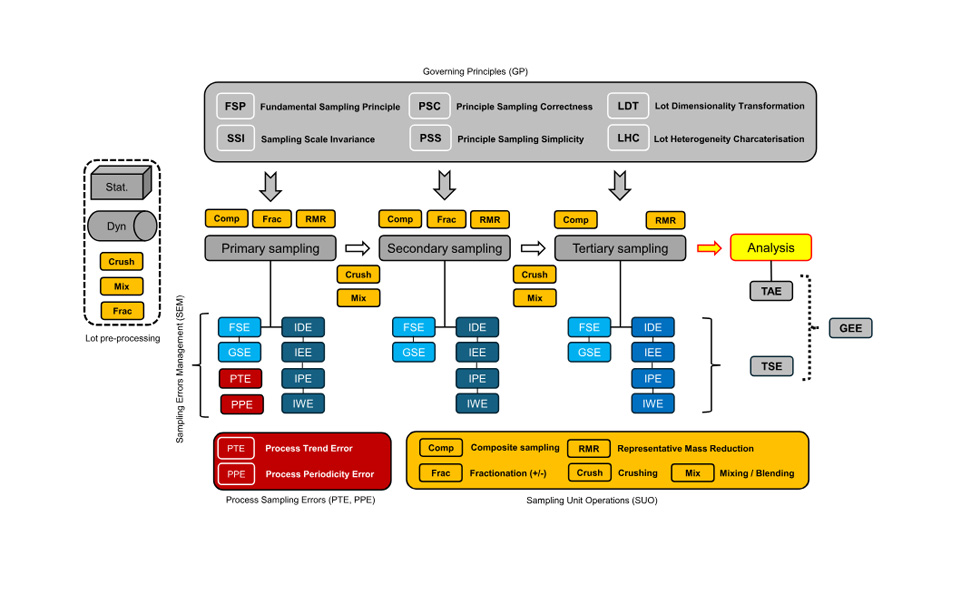
The TOS Framework
Theory of Sampling (TOS) is comprised by six Governing Principles (GP) (top grey panel), five Sampling Unit Operations (bottom yellow panel) and eight sampling errors (blue/maroon).
Learn more about the framework
Introduction to the Theory and Practice of Sampling
This book presents the Theory and Practice of Sampling (TOS) starting from level zero in a novel didactic framework without excessive mathematics and statistics. It represents 20 years of teaching experience which has developed into a unique conceptual framework.
Learn more about the bookpowered by